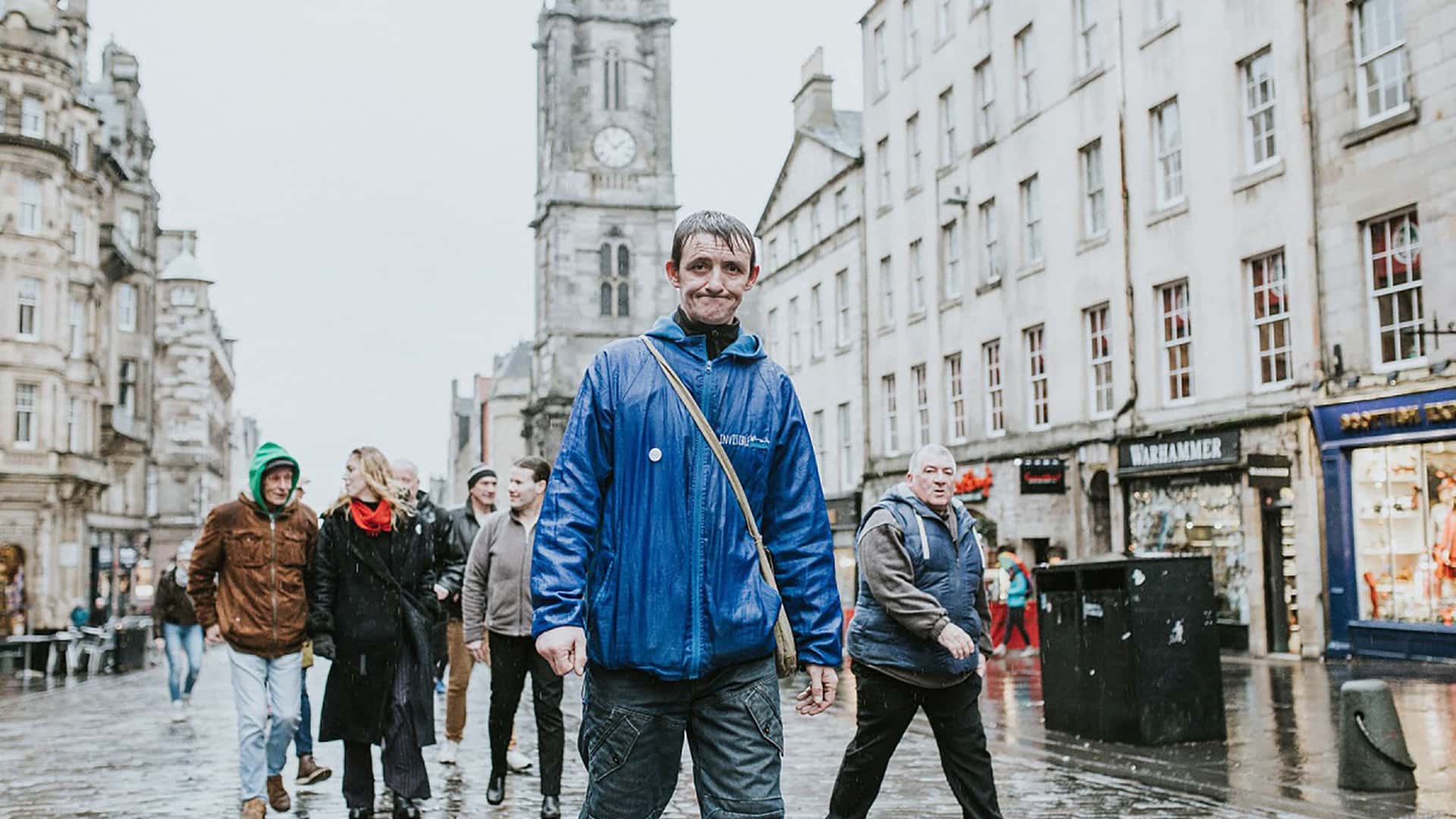
What’s your favourite hidden gem or lesser-known spot in the city that most tourists miss?
Most tourists miss out on Old Aberdeen full stop. Saint Matchers Cathedral my favourite Toblerone building. In the city centre I keep on discovering the artworks of Nuart Art. Castle Hill is a gem that is being missed a lot.
Can you share a powerful story from your tour that really stayed with you?
I am quite often impressed about European tourists; they are rather knowledgable about history.
What does being a tour guide with Invisible Cities mean to you personally?
It quite changed my life. I was selling the Big Issue, and I was already in my 50’s, so there was not really another option jobwise for me. I did enjoy selling the Big Issue, but I prefer being a tour guide, because it is more fulfilling.
Invisible Cities inspired me to learn more and make people have a happy time. I enjoyed all the social aspects with the get togethers and outings. It is a social, friendly, and really supportive organisation.
What part of your tour surprises people the most?
The factual history is often more interesting to guests than the myths.
How do you think your tour helps people see the city differently?
Partly through my own experience. I was a student, and I have lived in the area. My genuine passion for the factual history of Scotland. Allowing myths as a part of the cultural identity within the context of history.
What’s one historical fact or story you love to tell on your tour?
Bishop Elphinstone was supposed to be resting within the chapel but did not fit through the door without knocking out the stones. Thus, he is positioned outside the door where he gets greener and greener every day.
Why do you think it’s important for visitors to learn about homelessness during their trip?
Almost anyone has a wrong idea about homelessness. Homelessness is usually always referred to as problem by the media and the politicians as part of their agenda. We are a real-life contact as people who have experienced it without any political angle. We provide first-hand view.
What’s your favourite reaction you’ve had from someone on a tour?
It is kind of blended together. I always enjoy a genuine group thank you and some applause.
What do you hope people remember most after taking your tour?
I hope they remember the historical information and leave the tour with a happy impression. As well as, that walls have feeling too.
How has being a guide with Invisible Cities changed your life or perspective?
It has changed my life. It is lovely that I have received that niceness. It has not changed my perspective, because I always believed in people. It is comforting to know that so many people have made such an effort in running the organisation. Giving their time and effort. It is a confirmation about my faith in human nature.
More about Aberdeen and why you’ll want to visit and explore
Aberdeen often surprises visitors. Known as the Granite City, it’s a place where medieval lanes, North Sea trade, and the modern energy industry have shaped a city with far more personality than its grey stone first suggests. This is a walking tour that connects Old Aberdeen’s medieval origins, the fishing community of Footdee, and the North Sea oil boom.
What makes an Invisible Cities tour different is who tells the story. Our guides are people with lived experience of the city and its challenges, trained to share Aberdeen through personal perspectives as well as history. Expect engaging storytelling, unexpected local tales, and a chance to see places many visitors overlook. By joining the tour, you’re not only discovering the strange, surprising, and human stories behind Aberdeen’s streets – you’re also supporting a social enterprise that creates meaningful employment opportunities for people who have experienced homelessness.